


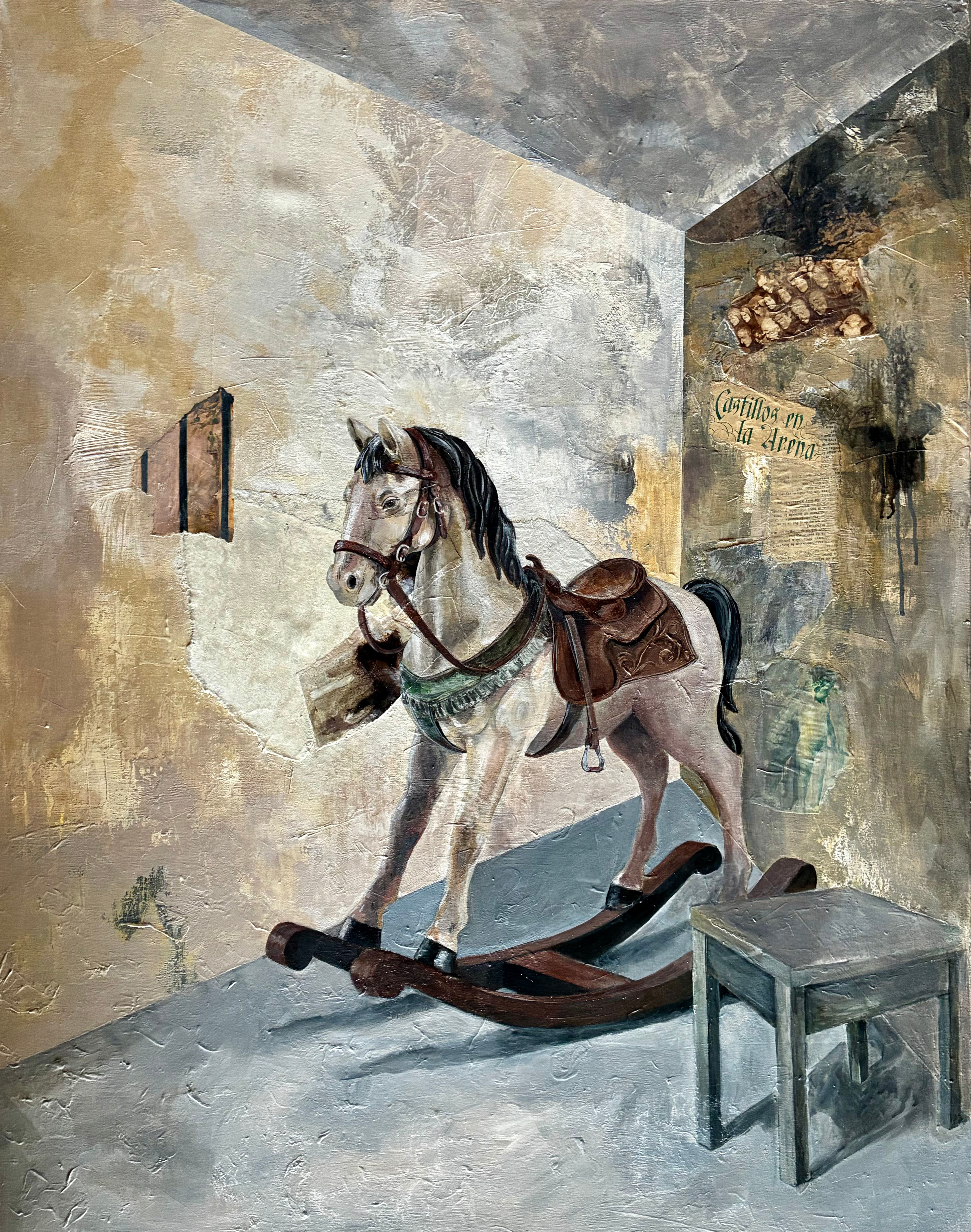

¿Dónde crees que vas?, 2026
Esta obra de arte pertenece a la colección La Otra Dimension. En esta pieza, construyo un escenario imposible donde las leyes de la perspectiva se quiebran para dar paso a un espacio simbólico que representa la mente. En el centro de la composición, un caballo-balancín como metáfora de un movimiento que nunca se convierte en avance real. Su vaivén constante alude a la ilusión de progreso generada por el ego: la sensación de estar recorriendo un camino cuando, en realidad, se permanece atrapado en los mismos patrones. Las máscaras, la figura del niño y la inscripción «Castillos en la arena» refuerzan esta reflexión sobre la identidad construida, los condicionamientos adquiridos desde la infancia y la fragilidad de las certezas sobre las que el ser humano edifica su existencia.
La presencia de un fragmento rasgado que evoca una jaula abierta introduce una paradoja esencial: la salida parece estar al alcance, pero la verdadera prisión reside en la identificación con el propio personaje y con las creencias que sostienen el ego. La atmósfera contenida, la paleta reducida y las superficies erosionadas suspenden la escena en un tiempo indefinido, entre la conciencia y el inconsciente, donde cada elemento adquiere un significado psicológico más que narrativo. Lejos de ofrecer respuestas, la obra invita al espectador a cuestionar hasta qué punto la dirección de sus pasos responde a un deseo auténtico o a una representación creada por la propia mente.
____
This artwork belongs to the series The Other Dimension. In this piece, I construct an impossible setting where the rules of perspective dissolve, giving way to a symbolic space that represents the mind. At the center of the composition, a rocking horse as a metaphor for movement that never becomes real progress. Its perpetual back-and-forth motion alludes to the illusion of advancement created by the ego—the feeling of moving forward while remaining trapped in the same repetitive patterns. The masks, the figure of the child, and the inscription “Castles in the Sand” reinforce this reflection on constructed identity, the conditioning acquired in childhood, and the fragility of the certainties upon which human beings build their lives.
A torn magazine fragment resembling an open cage introduces a central paradox: the possibility of escape appears to exist, yet the true prison lies in identifying with the self-image and the beliefs that sustain the ego. The restrained atmosphere, muted palette, and weathered surfaces suspend the scene in an undefined space between consciousness and the unconscious, where every element carries psychological rather than narrative meaning. Rather than offering answers, the work invites viewers to question whether the direction of their lives reflects an authentic search or merely a role shaped by the mind itself.
INFORMACIÓN TÉCNICA
Título: ¿Dónde crees que vas?
Año: 2026
Técnica: Técnica mixta sobre lienzo
Materiales: Acrílico y papeles tratados
Medidas: 80× 100 cm
Incluye Certificado de Autenticidad.
Envío gratuito a nivel internacional.
La obra se envía enrollada y cuidadosamente protegida en el interior de un tubo rígido reforzado. Este método de embalaje proporciona la máxima protección durante el transporte y minimiza el riesgo de daños.
Una vez recibida, la obra puede tensarse sobre un bastidor en una tienda especializada en enmarcación, lo que le permitirá elegir el acabado y la presentación que mejor se adapten a su espacio.
TECHNICAL DETAILS
Title: Where do you thing you're going?
Year: 2026
Medium: Mixed media on canvas
Materials: Acrylic and treated papers
Dimensions: 80 × 100 cm
Includes a Certificate of Authenticity.
Free worldwide shipping.
The artwork is shipped rolled and carefully protected inside a reinforced rigid tube. This packaging method provides maximum protection during transit and minimizes the risk of damage.
Upon arrival, the canvas can be professionally stretched over stretcher bars by a local framer, allowing you to choose the presentation and finish that best suits your space.


